18 July 2025
Reflections From the First Pets and Wellbeing Study (PAWS) Program Symposium: ISAZ 2025 Conference
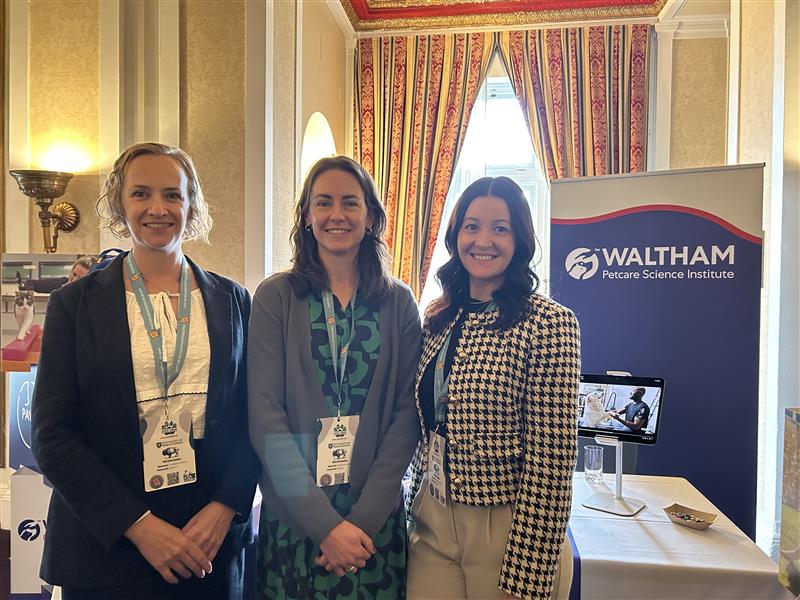
Dr Becky Smith Green
Senior Research Scientist, Waltham Petcare Science Institute
Share this post
We’re excited to share the highlights from our Waltham-led symposium at the ISAZ Conference last month!
Having recently returned from Canada, Waltham Petcare Science Institute Senior Research Scientist in Human-Animal Interaction (HAI), Dr Becky Smith, reflects on the Waltham HAI-led symposium that took place at the International Society for Anthrozoology (ISAZ) Conference earlier this month.
It has been a pleasure to bring the Pets and Wellbeing Study (PAWS) program to the 34th ISAZ Conference in Saskatoon, Canada! This annual conference is held to encourage the exchange and dissemination of knowledge related to research in the field of anthrozoology.
Along with some of our academic collaborators, the Waltham HAI team showcased a selection of studies from the global, multidisciplinary PAWS program in our symposium: ‘Pets and human mental health and wellbeing: Embracing complexity, context, and collaboration through an innovative Human-Animal Interaction research program’. The symposium gathered a large audience of both local and international attendees, including some wonderful dogs who joined us throughout the conference!
The symposium was chaired by Dr Vanessa Ashall, HAI Technical Leader at the Waltham Petcare Science Institute. The PAWS program is committed to supporting impactful HAI research, and the symposium showcased this by bringing together innovative studies and a range of disciplinary perspectives to discuss key advances and questions in the field.
At the Waltham Petcare Science Institute, we continue to drive robust research that advances our understanding of how we can best support pets and people in mutually beneficial relationships. Dr Megan Mueller from Cummings School of Veterinary Medicine at Tufts University described early research findings from her study investigating how relationships and interactions with pet dogs influence the mood and physiology of adolescents with social anxiety. Dr Mueller explained that social anxiety is common among adolescents. The mechanisms underlying youth-dog relationships in non-laboratory settings are understudied. While data collection is ongoing, preliminary findings from her study indicate that there may be a reduction in adolescents’ negative mood state during time spent with their own pet dog. So, watch this space for future updates!
Dr Lauren Powell from the University of Pennsylvania described her longitudinal research study which investigates pet adoption and human wellbeing across ranging socioeconomic positions. She explained that whilst people across the socioeconomic spectrum might benefit from pet ownership through mechanisms such as stress buffering, companionship and nonjudgement social support, challenges including housing discrimination or access to veterinary care may be experienced disproportionately by low- and middle-income families, and these may affect relationships with pets. Her talk demonstrated the feasibility of recruiting low- and middle-income adopters from animal shelters for studies of mental health. This is an important step in ensuring that HAI wellbeing research captures the experiences of diverse populations.
The conference was focussed on the ‘interconnected worlds’ of humans and animals, and Dr Emily Bray from the University of Arizona highlighted how talking to pets in everyday life is a key mechanism through which this connection occurs. Dr Bray walked the audience through her teams’ approach to analysing ‘pet talk’ data – audio recordings of owners talking to their pets. In collaboration with a Professor of Social and Personality Psychology, the team developed a coding system which represents the first standardised approach for analysing daily vocal pet-owner interactions. It will be used as part of an investigation into the role of pet-owner relationships in respect to older adults’ mental health and cognitive function. Measures of the human-animal bond as well as reports of human and animal wellbeing will be used alongside analysis of pet talk interaction style to understand how interactions affect wellbeing outcomes.
My own presentation outlined a collaborative ethnographic study focused on exploring wellbeing across multispecies families. It drew on themes of collaboration and methodological innovation, as well as the necessity to attend to animal subjectivity, agency and wellbeing in human mental health and wellbeing research. I proposed that viewing human-animal relationships as dynamic and co-shaping may help to shed light on cross-species dependencies as well as the ways in which caring for pets can enable new feelings to emerge or new ways to behave, with implications for multispecies wellbeing. I introduced the ‘multispecies family’ as an important concept in wellbeing research, and its relevance resonated during post-talk conversations.
Reflecting on all the symposium presentations was Dr Colleen Dell, Research Chair in One Health & Wellness, University of Saskatchewan. Dr Dell drew attention to the importance of the PAWS program in driving forward the field of HAI wellbeing research. As she invited the panel to reflect on their own research experiences, we heard about centrality of collaboration across disciplines, the need to understand context in HAI studies as well as the importance of centring animals. Dr Dell also described the need for a strengths-based approach in mental health support services, one that draws on a person’s strengths, assets and support networks to improve outcomes. Being mindful of this framework as opposed to individualistic or deficit-based approaches, is therefore also important to consider in the design of HAI wellbeing studies.
Following the discussion, I reflected on what a prioritisation of these approaches might look like in practice. Perhaps an emphasis on listening to the experiences and voices of underrepresented or vulnerable populations – both human and animal – provides a good starting point for driving research questions. Investment in research that explores the relationships of people and pets across ranging cultural contexts might also expand how we conceptualise wellbeing and help to generate relevant, real-world support for people and pets. Ensuring that we generate positive change through HAI research means not only understanding the context-specific nature of human-animal relationships, but ongoing investment to develop positive interventions such as those relating to relationship building, policy or behaviour change.
The PAWS symposium brought together research that is of relevance to human health and veterinary audiences alike. Within multispecies families, human and animal wellbeing becomes interwoven in complex and diverse ways. Both human and animal healthcare professionals will already recognise the messy boundaries between human and animal health and the difficulty of drawing lines between them. For veterinary teams, understanding the meaning and significance of multispecies family relationships is important as these shape veterinarians’ working lives. The need for support in navigating emotional or ethical challenges encountered in veterinary work is also increasingly recognised across the profession. Being equipped to explore how the pet-owner relationship affects the owner’s own health and wellbeing, as well as an awareness of an animal’s needs or where support for accommodating those needs may be sought, is increasingly relevant to human health care professionals and animal welfare workers. By bringing these conversations to the fore, the PAWS program can play a role in supporting a multispecies wellbeing which embraces their entanglement.
As I leave Saskatoon, I reflect on a fantastic few days shared with colleagues and friends, old and new. I finished my trip with a visit to the Wanuskewin Heritage Park, which was both an educational and humbling experience. I’d like to thank the local conference host committee – the PAWSitive Connections Lab – who did a fantastic job of demonstrating kindness and encouraging us to be curious as we continue our journey of understanding human-animal relationships. I hope you stay tuned for further updates as the studies in the PAWS program progress!